Showing posts with label braise. Show all posts

Tuesday, 4 May 2010

The Cambridge Menu

The brief from BBC Radio Cambridgeshire was simple: create a dish that sums up the area using the best locally sourced produce available.


Cornwall has the pasty, Bedfordshire’s got a clanger and Bury the black pudding – but Cambridge? Cambridge has…well, therein lay the problem. Our county is bereft of a classic.

The challenge to rectify this glaring omission came from our local BBC radio station. I would have a week to come up with something special and they’d then record me creating it in my own kitchen.

The obvious place to begin was looking at what local produce was available. It soon became clear that the area may be lacking in a signature dish but that isn’t for want of superb ingredients: locally reared beef, pork, lamb and game are plentiful, when in season.


In May, the Fens groan under the weight of the asparagus spears that peep through the earth. Celery and watercress also grow in plentiful abundance. The committed and enthusiastic loca-vore can even take their rod and line down to the River Cam and try to land a pike or zander. However, I didn’t think a week would be enough to organise a fishing licence (or actually learn how to fish).

Being bound to the fruits of the local land was no hardship, though and after a few days of hard research I came up with the following efforts for my Cambridgeshire Feast. Great British Menu, watch out.

Starter: Asparagus, bacon and egg
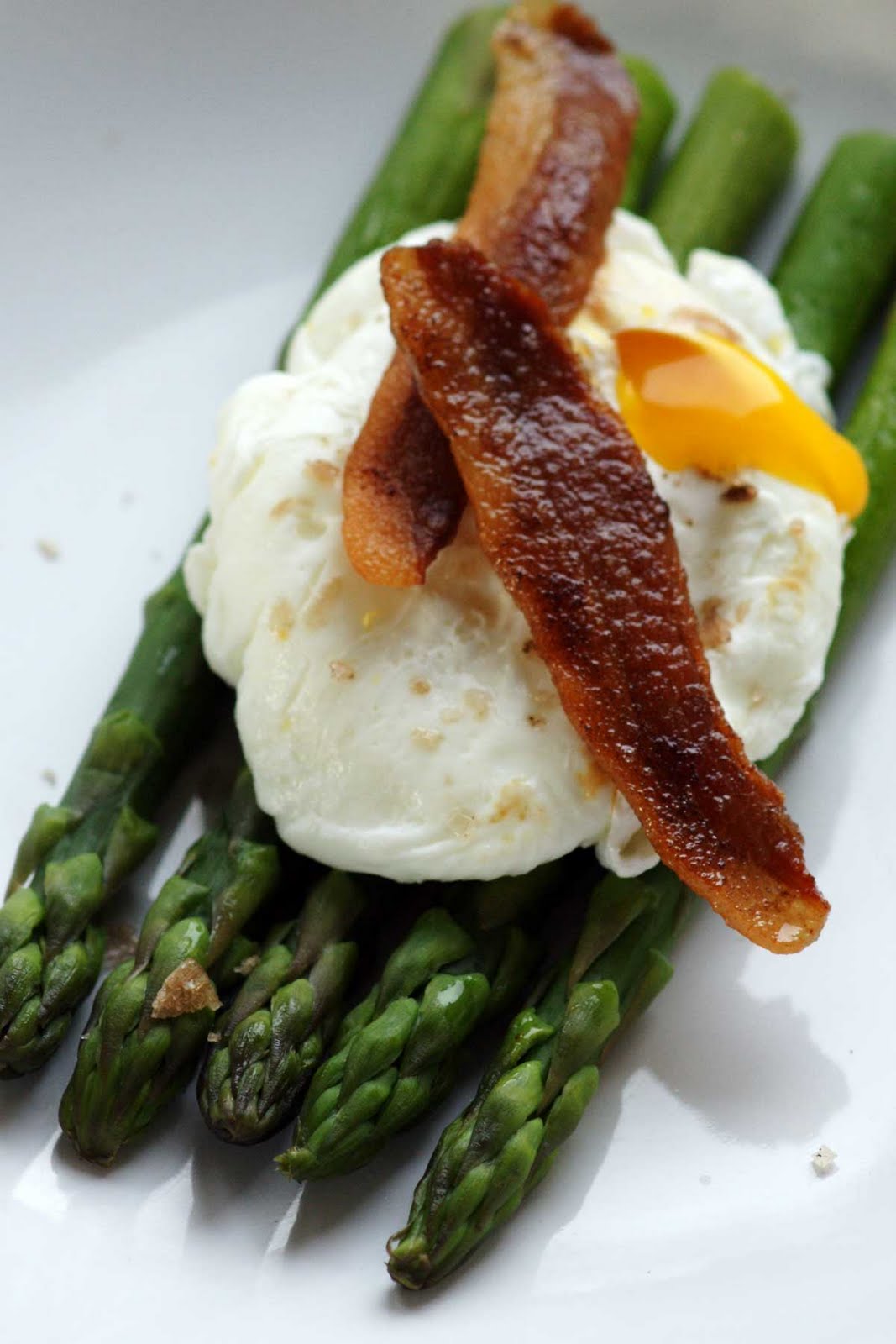


With it just sneaking into season, now is a great time to eat locally grown asparagus. The spears are sweet and tender and are yet to develop the slightly woody note that can tarnish the fern later in the year.

This isn’t a very original presentation but my goal was to keep it simple. The asparagus was steamed, brushed with butter then served with an egg (from our front garden) poached at 64˚and a couple of slices of home-cured pork jowl, uniquely preserved by the Cambridgeshire air and then fried until crispy like dry-cured streaky bacon.

Main Course: Beef cheeks, braised celery and Stilton and mustard cream


Beef and Stilton is a classic combination. Stilton and celery, likewise. Here they come together in a wonderful open pie.

Whilst most regions in Britain can lay claim to a local cheese, Cambridgeshire’s most famous dairy product can’t actually be made in the county. The PDO that proudly adorns Stilton cheese limits its production to the three counties of Derbyshire, Leicestershire and Nottinghamshire – but the town of Stilton itself lies within the boundaries of modern-day Cambridgeshire and here is where the cheese became justifiably famous.

Beef cheeks (from CamCattle, a company who locally rear cattle grazed on common land in the centre of Cambridge) were cooked slowly in red wine and stock with carrot, celery, onions and garlic until tender – then the cooking liquor reduced to a rich and sticky gravy.

The celery too, was braised by browning in a little butter then covering with a light chicken stock before being vacuum sealed and cooked for 35 minutes at 85˚ (the temperature at which pectin – the ‘glue’ that holds vegetables together –breaks down, making vegetables tender but ensuring they retain a little bite).


The celery and beef were topped with a disc of puff pastry and then a cool cream flavoured with Stilton and mustard was added to the dish, along with a some watercress for a peppery bite.

It may be a little optimistic to hope it’s a future classic, but one can always hope. It’s certainly delicious enough to warrant making again, very soon.

Dessert: Cambridge Burnt Cream with Rhubarb

Perhaps better known as crème brulee, this dessert was the closest that I came to finding a genuine heritage dish from Cambridge. Although the veracity of the origins of the dessert cannot be verified, legend has it that it was first served at Trinity College in the late 19th Century – a tale that Ian Reinhardt, head of catering at Trinity, was happy to stick to. As am I.


Rhubarb seemed a natural addition – both because it can be found all over the region at this time of year and also due to its natural affinity to custard: a pairing that almost universally tends to remind us of childhood.

Deceptively simple, the secret to a perfect ‘Burnt Cream’ lies in setting the custard to a soft texture without scrambling the egg yolk. Just don’t get it too hot.

Split a vanilla pod and add the seeds to 425ml double cream and gently bring to the boil. Whisk together 110g caster sugar with four egg yolks until pale then pour the cream over the yolks and sugar. Return to the heat and bring almost (but not quite) to the boil.

Pour the custard into ramekins and cook in a low oven (or bain marie) until set. Chill then sprinkle the tops with sugar. Use a blowtorch or hot grill to caramelise the sugar then cool.

For the rhubarb, melt 25g butter and 25g sugar in a pan. Add the sliced rhubarb then cover with orange juice. Cook until the rhubarb is tender (about 7-8 minutes), remove and reduce the liquid to a glaze to spoon over the soft rhubarb.


One final flourish that Ian kindly shared with me when I went to speak to him about the origins of this tasty pudding concerned the ‘branding’ of the caramelised sugar with a metal plate adorned with the college crest. A piece of theatre indeed, but perhaps a little extravagant for the home cook – at least, until I get my own coat of arms commissioned.

So – thoughts? Feedback? Outrage that I’ve missed a truly local classic? Get in touch in the comments or on Twitter and we’ll have a chat about it.

To listen to my Cambridgeshire menu appear on BBC Radio Cambridgeshire, click here (next 7 days only). It's at the 1 hour 20 ish mark. Just after Feargal Sharkey.

Pictures by @photolotte (flickr)

Monday, 16 March 2009

Nose to Tail Tuesday (N3T) - Lambs' Hearts

Not only are we moving away from the magnificent pig this week, having stuck resolutely to the extremities for the last fortnight (with cheek and tail), we’re heading towards the centre of the beast.

Right to the very heart, in fact.


Despite enjoying exactly the same biological construction as muscle tissue, the heart is firmly within the bracket loosely titled ‘offal’. Why? Because it does something. It performs a function, a function with which we are conspicuously familiar.

Whilst I’ve cooked the occasional pate, offal is not something I’m familiar with. Part of the philosophy behind this feature is to attempt to rectify this glaring omission in my culinary experience.

I’ll admit now that I am squeamish about certain things but I’m also rapidly learning to put aside my fears and prejudices. Partly because I think it important, partly because I hope it makes for good reading.

The same could also be said for my increasingly courageous and accommodating girlfriend. It’s one thing to cook ‘the nasty bits’ for yourself, quite another to foist them upon your loved ones.

‘I knew you were going to walk out of there with something odd,’ she said to me last Saturday as we exited the deceptively cavernous Middle Eastern supermarket on Cambridge’s Mill Road.

I tried to defend my actions, admittedly hard to do when clutching a small plastic bag containing two lambs’ hearts. ‘But they were only fifty pence each,’ I offered hopefully and somewhat ineffectively.

I failed to convince myself, despite my outward confidence.

‘It’s just like a steak,’ I added.

‘It’s not though, is it? It’s a heart. I know what it does and I’ve got one. I don’t have any steaks or fillets but I do have a heart. They are quite important.’

It was a good point. There is a linguistic difference when talking about meat: pigs become pork. Cows become beef and the names of the cuts are often comfortingly vague: rack of lamb, sirloin, brisket, fillet.

With offal it is a different story.

Offal speaks to you in plain language. Sure, there is the occasional softener (sweetbreads, for example) but mostly it is unadorned: liver, kidney, brain and heart. We can relate to these. We know what they do. We have them, as had been adroitly pointed out.

‘I really don’t think I can eat heart.’

This was going to be a challenge. But one I was looking forward to.

There are, it seems, three ways to cook heart. They can be stuffed and roasted, sliced and fried like a steak (no more than medium rare, unless you wish to be chewing on it for a month), or slow cooked in a braise.

Being a fan of the magical alchemy of slow cooking, I chose the latter, sure that if I could convince my most honest critic, I could convince almost anyone.

Braised Lambs’ Hearts with onion and black olive pie, spinach, nettle and mint puree, fondant potato and glazed carrots


Once the sinew and fat has been trimmed away and the heart meat cut into manageable pieces, it takes on a more familiar appearance. It looks, to all intents and purposes, like meat.

Knowing what works, all that was needed was to coat the pieces in seasoned flour, brown them in a hot pan then add them to the Le Creuset along with some onion, garlic, carrot and rosemary. Topped up with red wine and lamb stock, the whole lot goes into a cool oven to cook away for at least two hours.

This is, generally, a good approach to take with any number of cheap cuts which need the low temperatures and lengthy cooking times to break down the connective tissue and collagen that holds the meat together. The benefit is a deliciously rich and unctuous stew with meat as tender as any prime cut.

While spoonfuls of this could easily be served alongside a baked potato or underneath a golden pie crust, the Thomas Keller school of cookery (and if anyone knows a thing or two about food, it is that man) advocates discarding the vegetables (which have already imparted its flavours into the pot), removing meat and reducing the sauce down to a thick, sticky jus.

So that’s what I did.

100ml of cassis liqueur was added to a pan along with the same amount of gravy from the stew and a few cubes of frozen beef stock. A couple of sprigs of rosemary and a split clove of garlic were also dropped in before the whole lot was reduced down. After passing through a fine sieve, the meat was returned back to the jus to warm through.

Although refined, this dish screamed ‘hearty’ (excuse the pun). And what could be heartier than a pie?

I remembered reading somewhere that in parts of France, lamb is often served with black olives. It seemed like a flavour combination that would work so I fried off some onions in olive oil, added some finely chopped black olives and then made a basic vegetable suet pastry to house the faintly sweet mix. Brushed with eggwash, they took barely ten minutes in a hot oven.

Mint is also a classic accompaniment with lamb but instead of a sweet and vinegary mint sauce of the type that graces dinner tables across the land every Sunday, I plumped for a more delicate side of spinach, nettle and mint puree (cook the leaves – one part fresh mint, one part nettle, two parts baby leaf spinach – in a little water, blitz, drain and season).

For the rest of the vegetables, sweet glazed carrots and fondant potatoes, cooked in a little chicken stock, completed the dish.


So, to get to the heart of the matter (sorry), how was it?

It wasn’t just surprisingly good, it was deliciously good. It was the sort of food that somehow has the ability to make you very happy indeed. It was rich, tasty, satisfying and all those other things that go into making a successful braised dish.

The heart had a deep flavour though not over-powering. It was ever so slightly ferric, like very mild liver but also deeply meaty. Texturally it had bite but wasn’t chewy or tough. The small morsels offered a little resistance but more than compensated in flavour. This is everything that is good about food.

‘Can I quote you?’ I said to my girlfriend after she had proclaimed it ‘completely delicious, so good. It’s possibly the best thing you’ve ever cooked. I can’t believe you got me to eat heart and enjoy it this much! Mmmmm, so, so good!’

‘Of course you can quote me,’ she replied. So I just did.

Verdict: N3T – Lambs’ hearts: a complete and utter success. Do again? With absolute certainty. And at fifty pence a go, it is almost sacrilegious not to buy these when they are available.

Any changes? Serve with buttery mash and wilted spinach. Simple, hearty and, in the words of my girlfriend ‘so, so good.’

Follow me on Twitter